Understanding the Importance of underlayment in Class A Roofing Fire Ratings
In the roofing industry, "Class A" is often treated as a binary checkbox — a technical requirement to be satisfied before a permit is issued or a bid is accepted. But as fire-prone regions expand and building codes tighten, the selection of a roofing system with a Class A fire rating has become critical for many projects.
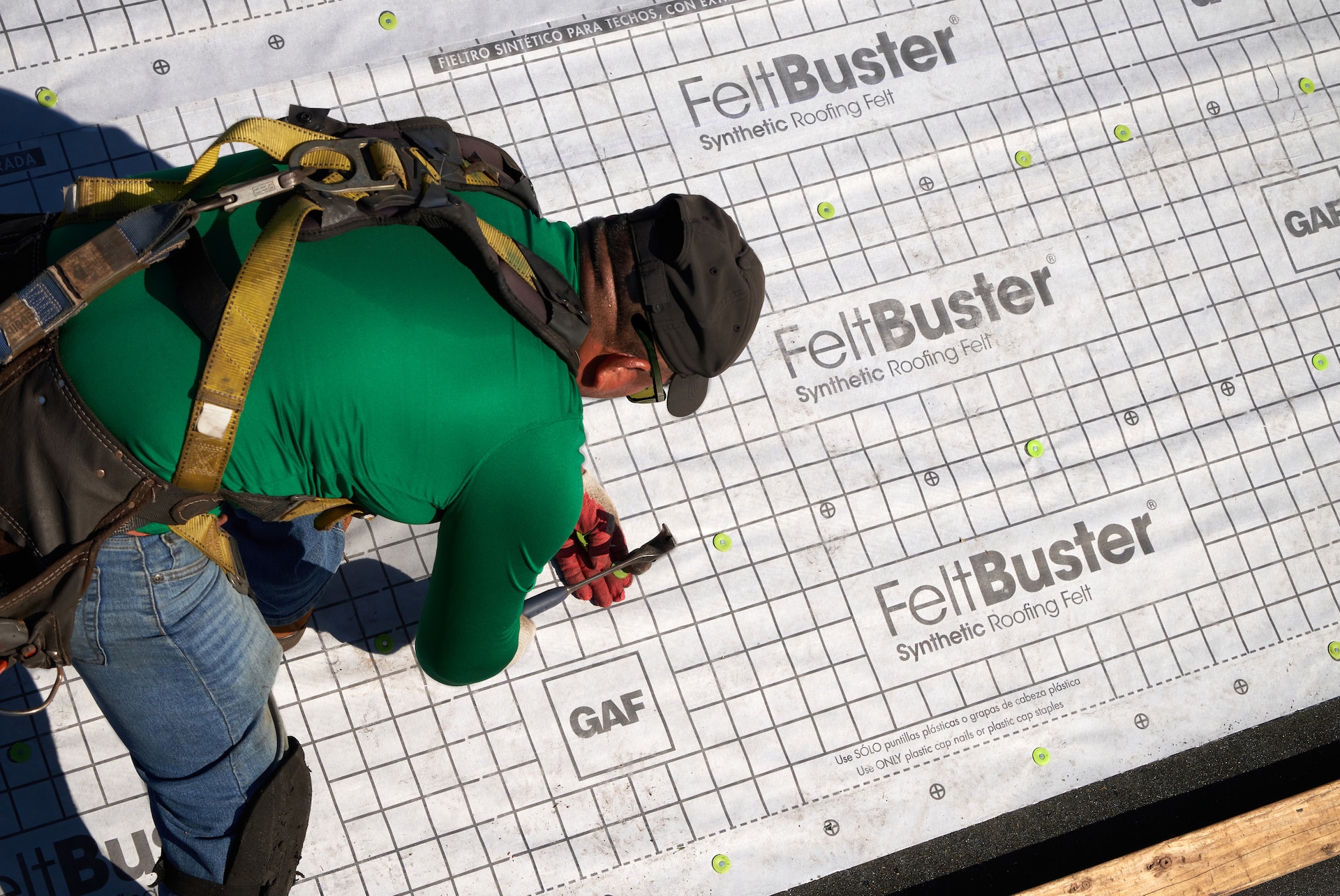
GAF recently hit a significant milestone: its entire line of synthetic underlayments[FN1], including the recently enhanced FeltBuster®, can be used to achieve a UL 790 Class A roofing fire rating as a component of UL Classified roofing assemblies.[FN2]
How Roofing Fire Ratings are Determined
It’s a common misconception that an underlayment carries a fire rating on its own; in reality, UL 790 and ASTM E108 fire ratings apply to the entire roof assembly—the combination of the deck, underlayment, and primary roof covering.
The UL 790 standard evaluates how an assembly resists external fire under controlled laboratory conditions through three rigorous tests:
Spread of flame test: The assembly is subjected to 1400 F flame and 12 mph simulated winds. For a Class A rating, the flame spread on the surface of the roof cannot exceed 6 ft in 10 minutes.
Intermittent flame test: The assembly is exposed to repeated cycles of flame (on for 2 minutes, off for 2 minutes) and 12 mph simulated winds. To pass Class A, there must be no flaming on the underside of the plywood deck after 15 cycles.
Burning brand test: A 12 x 12 inch 4.4 pound flaming wooden brand is ignited and placed on the roof. To achieve Class A, there must be no flaming on the underside of the plywood deck within 90 minutes.
When selecting underlayment, it’s important to understand the specific combination of products required for the roofing system to achieve a Class A rating by examining the listing with an accredited agency such as UL Solutions. If an underlayment must be paired with a shingle of a minimum weight or a minimum ½-inch plywood deck to achieve Class A, failure to do so may result in an unrated system.
All GAF synthetic underlayments[FN1] when paired with a GAF asphalt shingle—from our best-selling Timberline HDZ® to our premium Designer collection achieve a UL 790 Class A fire rating over a minimum 3/8-inch plywood deck[FN2].
Proprietary: The Fire Barrier Technology
GAF did not achieve this versatility by accident. It required a complete rethink of product construction. GAF synthetic underlayments — DeckArmor™, TigerPaw™, and now FeltBuster®—feature unique, proprietary fire barrier technology to help achieve a Class A fire rating. This represents a significant advancement in our synthetic roofing underlayment technology.
"Tested vs Certified": Why it Matters
When a roofing product is just “Tested” in accordance with a specific standard it typically means that a manufacturer sent a sample of the product to a third party laboratory for testing or conducted the testing internally.
If a product is “Certified” by an accredited agency like UL Solutions, it means the product has been tested and meets the identified standards, is included in a directory published by the organization and is subject to ongoing inspections and testing to verify continued compliance.
Many building codes mandate specific fire classifications for roof assemblies based on building type and other factors. When a Class A, B, or C rating is required, the assembly must be tested per ASTM E108 or UL 790 and included in a list published by an accredited agency like UL Solutions.
All GAF synthetic underlayments[FN1] achieve an ANSI/UL 790 Class A roofing fire rating as a component of UL Classified roofing assemblies.[FN2]
When a professional sees the UL mark on a roll of GAF synthetic underlayment, it represents a symbol of trust.
Filling the Price Gap for Specified Jobs
Historically, achieving a Class A rating with a GAF synthetic underlayment required moving up to premium options like TigerPaw™. For price-sensitive projects, such as large-scale new constructions, multi-family housing, or HOA residences—this often created a budget gap.
The upgrade of GAF FeltBuster® helps change the math. It provides a cost conscious option for specified jobs that require a sharp price point.
This is particularly critical in regions with a growing emphasis on Wildland Urban Interface (WUI) compliance. In states like California, Texas, Florida, North Carolina, and Pennsylvania, Class A fire-rated systems are increasingly mandated for roofing installations. Contractors in these areas can now construct a roofing system that meets these stringent Class A requirements at every price tier using GAF shingles and synthetic underlayments.
A Commitment to Quality
By choosing GAF synthetic underlayments, professionals are choosing:
Proprietary Innovation: Unique technology designed to help achieve a Class A fire rating.
UL Classification: All GAF synthetic underlayments[FN1] when paired with a GAF asphalt shingle achieve a UL 790 Class A fire rating over a minimum 3/8-inch plywood deck[FN2].
Rigorous Oversight: UL inspections to ensure continued compliance.
[FN1] Includes, Feltbuster, Tiger Paw and Deck Armor roof deck protection
[FN2] Achieves ANSI/UL 790 Class A roofing fire rating as a component of UL Classified roofing assemblies. Applies only to products sold in packages bearing the ANSI/UL 790 Class A classification statement. Refer to UL Product iQ for specific assemblies. Testing performed under controlled laboratory conditions by UL Solutions. GAF makes no express or implied warranty about the fire performance of these products. Fire damage is not covered under the limited warranty. See GAF Shingle and Accessory Limited Warranty available at gaf.com/warranties for complete coverage and restrictions.
