When and How to Install Silicone Commercial Roof Coatings
Silicone coatings offer a convenient and cost-effective commercial roofing solution. Among other advantages, they can improve a building's energy efficiency and protect the roof from standing water. As an added benefit, the installation process is relatively straightforward.
Understanding the ins and outs of commercial roof coatings-and being able to make recommendations for specific situations-can help you build trust as a reliable contractor who focuses on quality. Here are the key details to know about silicone roof coatings and best practices for installing them.
Why and When to Use Silicone Coatings
Silicone coatings have the flexibility and strength to withstand extreme temperatures and intense sunlight, making them a great option for commercial applications in virtually any area. Laura Soder, senior product manager for liquids and coatings at GAF, explains that this roof coating is used in both northern Canada, where winter weather is freezing cold, and in South America, which has humid tropical conditions.
You might opt for silicone roof coatings for several reasons, depending on a building's location and your client's needs.
Provides Water Resistance
Silicone coatings are great for applications where you need ponding water resistance. The material is inorganic, so it doesn't absorb any moisture. Soder notes that these products are commonly used in regions that experience seasonal weather events. "It's quite popular in the Pacific Northwest, Northeast, Midwest, and Southeast where you get a lot of snow and rain," she says.
Withstands Temperature Swings
Silicone commercial roof coatings are also an excellent solution for locations with temperature fluctuations. Roofs can expand and contract as temperatures change; sometimes they can experience thermal shock. If a roof heats up during the day and the temperature drops at night, roofing system components can expand and contract rapidly over and over. This process can cause other roofing materials to become brittle and crack-but silicone can flex, move, and stretch with the roof's changes.
Offers Solar Reflectance
Since GAF silicone is formulated with titanium dioxide, it provides high solar reflectance capabilities. This ultraviolet (UV) resistance makes it ideal for roofs in areas that receive a lot of sunlight and for clients looking for ways to help improve their building's energy performance.
Easy to Install
Silicone coatings also offer ease of application, especially for job sites that are difficult to access. You can put buckets of silicone in the elevator and roll it out with a squeegee or paint rollers without the risk of overspray in high-rise buildings. You don't need heavy equipment for application.
How to Install Silicone Coatings
Soder notes it's important to follow specific steps when installing silicone roof coatings on commercial structures.
1. Clean the Surface
First, clean the roof, removing any dust or debris. If the roof is dusty, the coating will adhere to the dust instead of the substrate, causing adhesion issues and potentially leading to blisters. "If you do not prepare your roof before you coat it, you're setting yourself up for failure," Soder warns.
Choose a trisodium phosphate (TSP) cleaner or a specialized one like GAF Cleaning Concentrate that helps remove dirt and other pollutants. Use a power washer with these cleaners for the best effectiveness. "It's imperative that a roof is free of dust, debris, contaminants, or anything that would affect the adhesion of the coating," says Soder.
Wash off the cleaner residue and allow the roof to dry before coating. Silicone is moisture cure, so it will lose adhesion if the roof isn't dry since it cures from the bottom up.
2. Perform an Adhesion Test
After cleaning the roof, conduct an adhesion test. Soder notes this test is essential for any roof where you're applying a coating. "If an adhesion test fails, you can use a primer to help increase the adhesion to certain substrates," she says. "Newer substrates can be harder to stick to than aged substrates since as roofs degrade, they become easier to adhere to."
3. Seal All Seams
Next, check the roof's condition and fix any issues, such as replacing fasteners or flashing. Then, apply GAF Silicone Mastic sealant to the seams, drains, and roof penetrations before installing the coating. These are the vulnerable areas of a roof that experience the greatest amount of movement.
Higher viscosity sealant is more appropriate for a vertical surface like HVAC units, pipe penetrations, flashings, scuppers, and drains. "GAF silicone roof sealants are formulated differently and made with a stronger backbone to get the physical properties required for the critical points in the roof," Soder says. Apply it at 60 mils or 1/16-inch wet thickness with a brush.
4. Apply Commercial Roof Coating
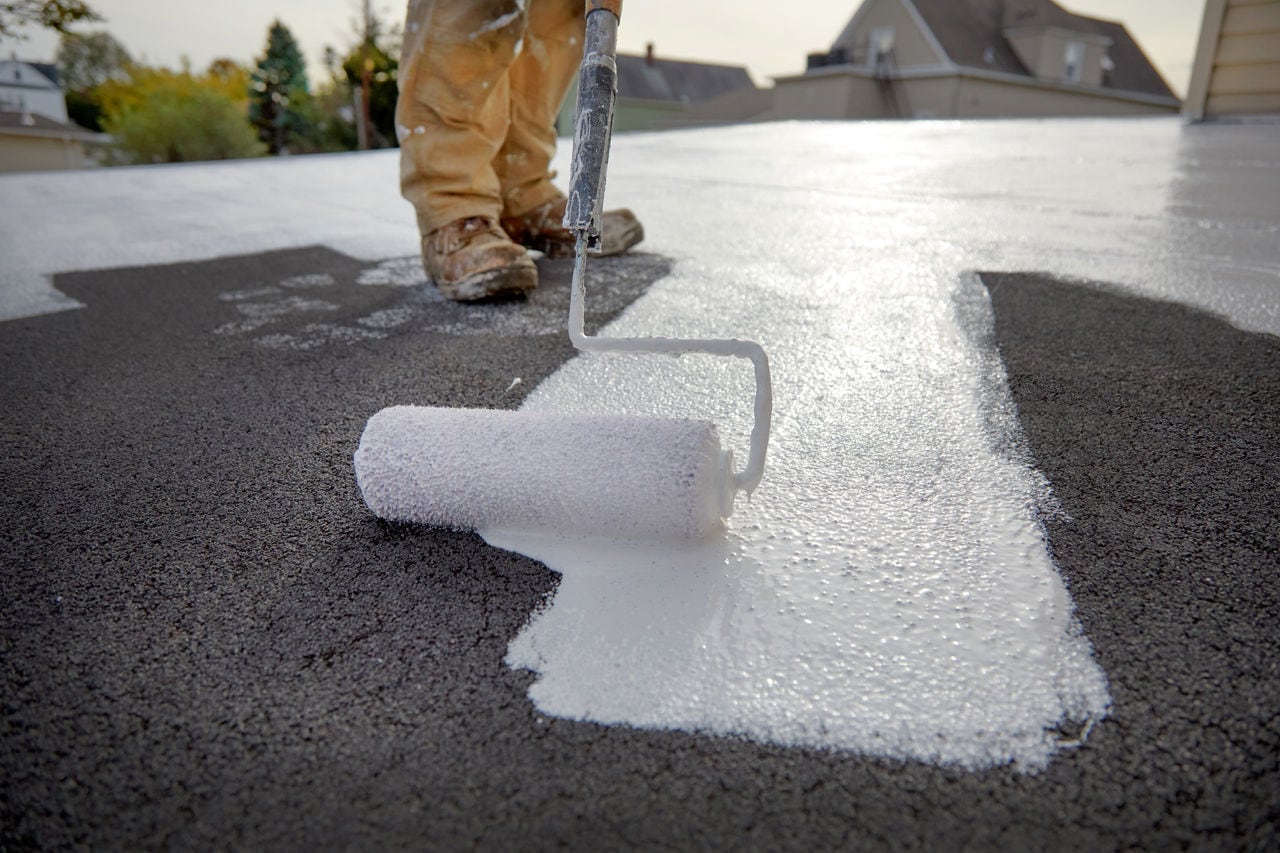
Finally, apply a high-performing silicone coating like GAF Unisil Silicone Roof Coating or GAF Unisil High Solids Silicone Roof Coating using either a roller, brush, or spray. Unisil Silicone requires two coats, while Unisil High Solids Silicone only requires one if the roof slope is 2:12 or less. If the slope is steeper, two coats are recommended.
You must achieve a certain mil thickness to meet the warranty. For silicone, the required minimum is 1,5 gallons, but all manufacturers have their own minimum application coverage. As warranty duration increases, your coverage requirements also increase. For GAF silicone, 1,5 gallons can get you 10 years of coverage, 2 gallons get you 15 years, and 2,5 gallons get you 20 years.
"GAF silicone is tack-free in 60 to 90 minutes and offers a full cure in four to six hours," Soder explains. The more coating and sealant you put down, the longer it can take to cure. With high-solid silicone, it cures through at any thickness.
Maintaining Silicone Coatings
Maintaining silicone coatings is straightforward, and you can often address any deficiencies on the roof with silicone sealant. Soder mentions that all silicone sealants are UV stable, so they don't need a top coat.
What's more, any GAF silicone sealant and coating can also go over and under each other. So if you do your typical six-month checkup on the roof and find any issues like small openings near the seams, silicone sealant can fix it.
At the end of the warranty period, you can recoat silicone. Silicone coating's sustainability and life cycle are some of its main selling points. You don't need to tear it up, and you can add another coating (as long as the roof is in good shape) and get another warranty for your clients.
If you're interested in using quality silicone coatings in your projects, contact your local GAF territory manager for more information and support.
