Updated September 2026
In the U.S., hailstorms cause billions of dollars in property damage annually. In 2025, damaging hail affected more than 600,000 homes, with a combined reconstruction cost of $177 billion. Almost half of all residential insurance claims are related to hail damage, most involving roofs. As a homeowner, it's important to know your risk level and help protect your home with the best roofing.
Roof shingles are ranked from Class 1 to Class 4 regarding their impact resistance, with Class 4 being the highest rating. When comparing Class 3 vs. Class 4 shingles, an understanding of the costs, potential benefits, and possible insurance discounts can help you make the right choice for your home.
Understanding Shingle Impact Resistance Classifications
Roofing shingles are tested for their degree of impact resistance by simulating impacts under controlled laboratory conditions, then recording and classifying the results. Underwriters Laboratories (UL), a global testing and certification agency, developed the UL 2218 standard, which uses steel balls of varying sizes dropped twice on installed shingles from specific heights.
The following table shows the UL 2218 impact resistance rating requirements for shingles in Class 1 through Class 4:
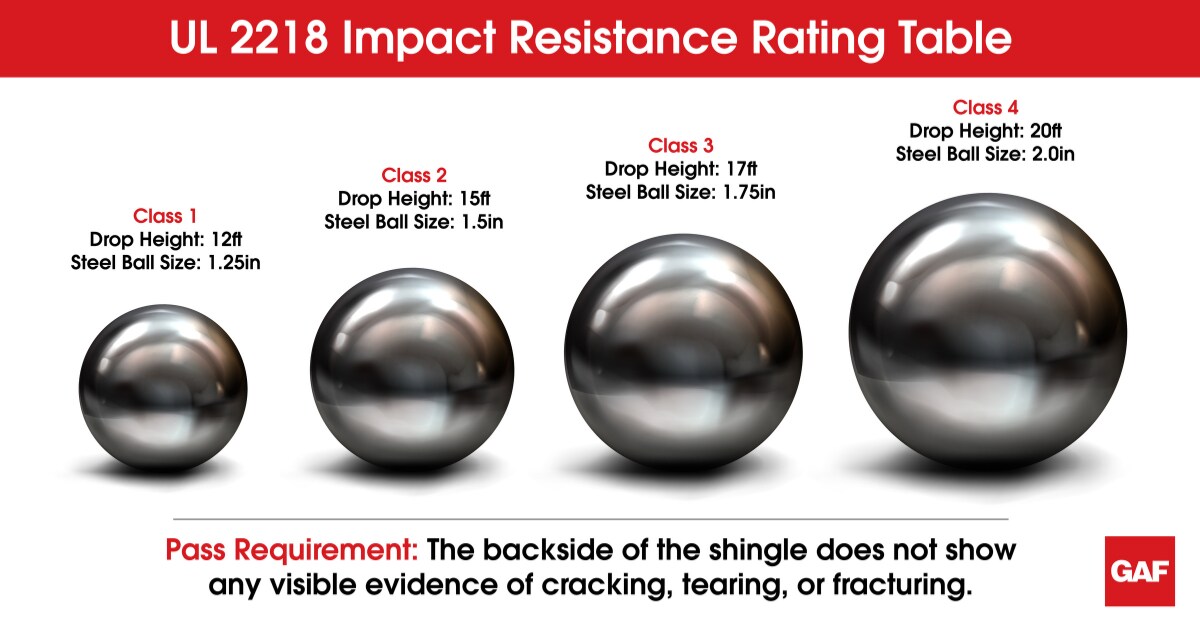
Class 1 is tested with a drop height of 12 ft with a steel ball size of 1.25in
Class 2 is tested at a drop height of 15 ft with a steel ball size of 1.5in
Class 3 is tested at a drop height of 17 ft with a steel ball size of 1.75in
Class 4 is tested at a drop height of 20 ft with a steel ball of 2.0 in
In order to pass all tests, the backside of the shingle can not show any visible evidence of tearing, cracking, or fracturing.
Are Class 3 shingles impact resistant?
Since Class 4 is the highest rating, are Class 3 shingles also considered to be impact resistant? Absolutely. In evaluating Class 3 vs. Class 4 shingles, Class 3 indicates that the shingle withstands the impact of a 1.75 inch steel ball dropped from 17 feet in lab testing.
Although almost two-thirds of the U.S. is susceptible to hailstorms, they tend to vary in strength and severity depending on location. FEMA has established a National Risk Index Map that rates a community's relative risk for hail when compared to the rest of the United States. Class 3 shingles may be appropriate for areas with a low risk of severe hail.
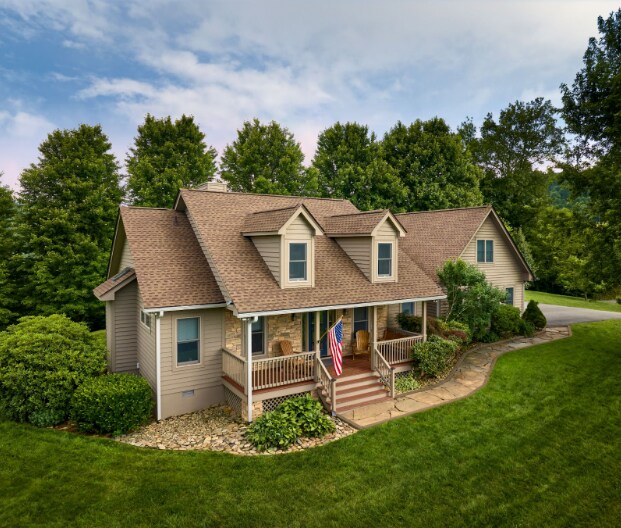
GAF Class 3 Roof Shingles
GAF offers Class 3 rated shingles [FN 1,2] including the following:
Timberline HDZ® [FN3]
Timberline HDZ® RS [FN3]
If you live in an area with a lower-risk of hail, prioritize affordability and want a roof with great aesthetics, GAF Class 3 shingles are a strong fit. Not only do they carry a Class 3 impact rating, but they also pass ASTM D3161 (Class F) and ASTM D7158 (Class H) wind resistance tests with the highest ratings[FN4]. Plus, selecting Timberline HDZ® or Timberline HDZ® RS shingles—along with four required GAF accessories—unlocks a 15-year WindProven™ Limited Wind Warranty[FN5] with infinite wind speed protection for your shingles.
GAF Class 4 Shingles
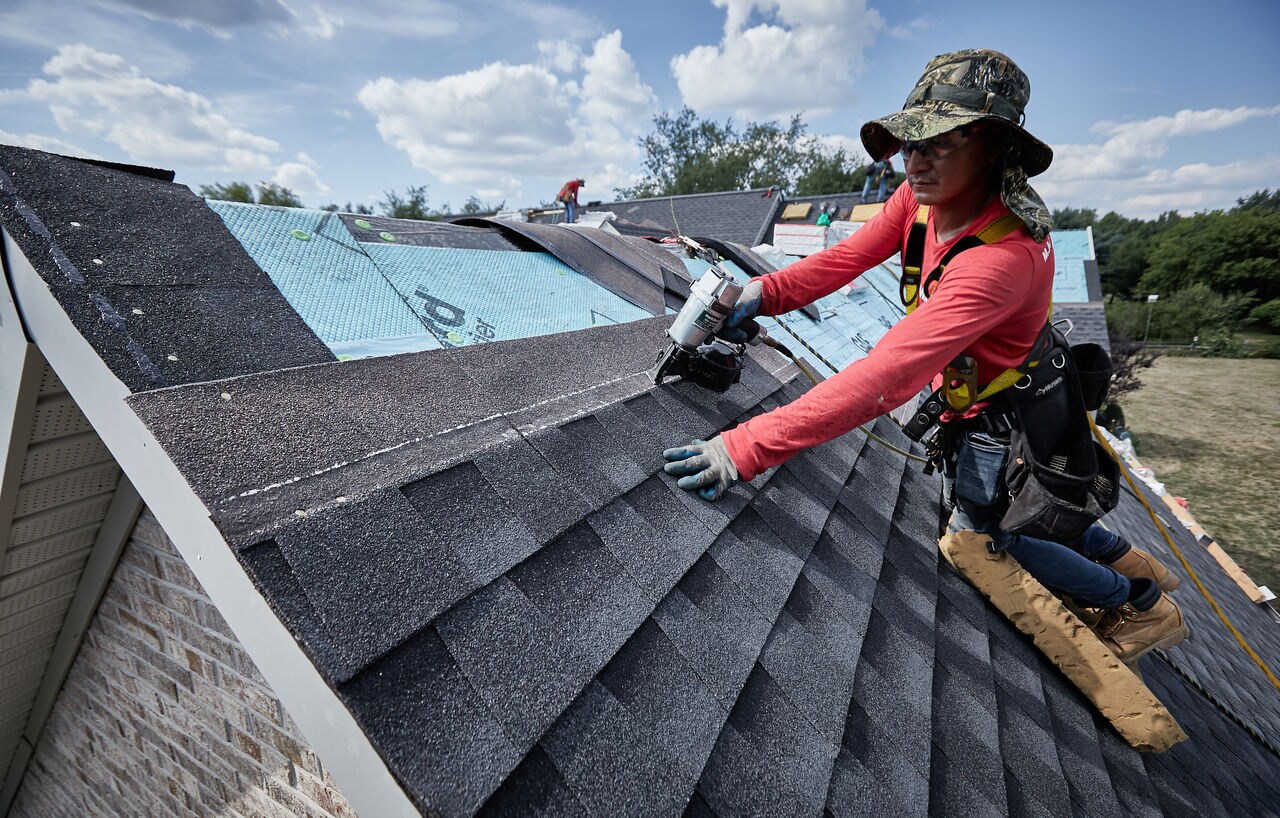
GAF also offers a variety of Class 4 impact rated shingles[FN1,6], that may provide a better option for higher risk hail areas. Select products, such as Timberline® AS II [FN7] and Grand Sequoia® AS [FN7] shingles achieve their Class 4 rating using proprietary SBS-modified asphalt technology that provides excellent flexibility to help reduce impact stress on the shingle. This flexible formula helps absorb impacts, enhances crack resistance, and allows shingles to lay flatter in colder weather (40°F or higher) compared to our standard asphalt shingles—making them a dependable option across varying climates.
Other options, like Timberline UHDZ® shingles, feature UltraMat™ high-performance mat technology to achieve their UL 2218 Class 4 rating[FN8]. Additionally, GAF offers several other shingles that pass the UL 2218 Class 4 test, including Grand Sequoia®, Grand Sequoia RS®, Camelot II®, Woodland®, and Slateline® [FN8].
Because severe storms can bring both hail and high winds, GAF Class 4 shingles also earn top ratings on the ASTM D3161 (Class F) and ASTM D7158 (Class H) wind resistance tests[FN4]. Furthermore, when installed with four required GAF accessories, shingles like Timberline® AS II and Timberline UHDZ® qualify for the 15-year WindProven™ Limited Wind Warranty with no maximum wind speed limit[FN5].
Class 3 vs. Class 4 Shingles: A Comparison
Here are the main points to consider in comparing Class 3 vs. Class 4 shingles:
Testing
In lab testing, Class 3 shingles withstand the impact of a 1.75in steel ball dropped height of 17 ft while Class 4 shingles withstand the impact of a 2.0 inch steel ball dropped from 20 ft without the backside of the shingle showing visible evidence of tearing, cracking, or fracturing [FN1].
Limited Warranties
GAF Class 3 and Class 4 shingles offer a Lifetime Limited Warranty on manufacturing defects [FN9], plus a 25 year algae protection limited warranty (30-years exclusively for Timberline® UHDZ® shingles) [FN9]. With special installation, they are warranted to withstand wind speeds up to 130 mph [FN9]. Furthermore, GAF Class 3 shingles and select GAF Class 4 options such as Timberline AS II and Timberline UHDZ qualify for the 15-year WindProven Limited Wind Warranty with no maximum wind speed limit when installed with 4 required GAF accessories[FN5].
Potential Insurance Benefits
Insurance providers in certain locations may offer discounts for Class 3 and Class 4 shingle roofs. [FN10]
Discounts may be greater for Class 4 shingles.
To verify availability and eligibility, consult with your insurance company. You may be required to provide documentation from your roofing contractor and possibly a detailed report from a certified roofing inspector.
Cost
Class 3 shingles are typically more affordable than Class 4 shingles and are a good option in areas with lower hail risk—plus, they may result in discounts on your homeowners insurance premiums.
Class 4 shingles are typically higher cost, may be a good option in areas with a higher-risk of hailstorms and may provide more substantial insurance discounts.
Making the Right Choice for Your Home
Choosing Class 3 vs. Class 4 shingles for your home is an important decision that will depend on:
Hail Risk: Class 4 shingles may be a better option for areas where there is a higher risk of hail while Class 3 shingles may be more appropriate in lower risk areas.
Budget: Class 3 shingles are typically more affordable than Class 4 shingles.
Insurance: Class 4 shingles may qualify for higher insurance discounts than Class 3 shingles [FN10].
Local Codes: Some jurisdictions in high-risk areas may require Class 4 shingles. Always check local codes for requirements in your area.
Choose a GAF Master Elite® contractor[FN11] to install your Class 3 or Class 4 shingle roof. Master Elite® contractors are certified by GAF and can offer extended warranties for your roof. They can advise you on the best roofing for your location, budget, and code requirements.
Learn more about GAF impact-resistant roof products or find a GAF-certified Master Elite® contractor here.
[FN1] GAF makes no express or implied warranty about the impact performance of these products against hail. Hail damage is not covered under the limited warranty. See GAF Shingle and Accessory Limited Warranty available at gaf.com/warranties for complete coverage and restrictions.
[FN2] For purposes of this article, GAF Class 3 shingles refers to Timberline HDZ® Timberline HDZ® RS.
[FN3] Only products sold in packages bearing the UL2218 Class 3 PRI Validation Program statement are rated for Class 3 impact resistance. Testing performed under controlled laboratory conditions by Certerra Analytical - PRI.
[FN4] Testing conducted under controlled laboratory conditions. Warrantied wind speeds may be lower than tested wind speeds. See GAF Shingle and Accessory Limited Warranty for complete coverage and restrictions.
[FN5] 15-year WindProven™ limited wind warranty covers GAF Shingles with LayerLock® Technology only and requires the use of GAF Starter Strips, Roof Deck Protection, Ridge Cap Shingles, and Leak Barrier or Attic Ventilation. See GAF Roofing System Limited Warranty for complete coverage and restrictions. Visit gaf.com/LRS for qualifying GAF products. For installations not eligible for the WindProven limited wind warranty, see GAF Shingle & Accessory Limited Warranty for complete coverage and restrictions.
[FN6] For purposes of this article, GAF Class 4 shingles refers to Timberline® AS II, Grand Sequoia® AS, Timberline UHDZ, Grand Sequoia®, Grand Sequoia RS®, Camelot II®, Woodland®, and Slateline®.
[FN7] UL2218 Class 4 classified for impact resistance. Testing performed under controlled laboratory conditions.
[FN8] Only products sold in packages bearing the UL2218 Class 4 PRI Validation Program statement are rated for Class 4 impact resistance. Testing performed under controlled laboratory conditions by Certerra Analytical - PRI.
[FN9] See GAF Shingle and Accessory Limited Warranty for complete coverage, restrictions and special installation requirements.
[FN10] Insurance discounts are not guaranteed and may vary, if available. Contact your insurance provider for information.
[FN11] Contractors enrolled in GAF certification programs are not employees or agents of GAF, and GAF does not control or otherwise supervise these independent businesses. Contractors may receive benefits, such as loyalty rewards points and discounts on marketing tools from GAF for participating in the program and offering GAF enhanced warranties, which require the use of a minimum amount of GAF products. Your dealings with a Contractor, and any services they provide to you, are subject to the GAF Contractor Terms of Use.
